


Political ad buyers want to talk to voters. And voters read and watch local news. That’s why the “A” block of every local news station’s 6 p.m. broadcast is filled with political ads. Those buyers are talking to people they know to be voters — your readers.
Political advertisers — like all of us — are creatures of habit, and they spend large portions of their budgets on streaming video. Almost nothing is better, more concise and, um, spot-on than a well-produced :30 or :15 video.
Yet, for all its popularity, streaming video isn’t ubiquitous. In 2024, the Federal Communications Commission said that 45 million U.S. households didn’t have high-speed broadband access — a must-have to stream video. Last year, a trade group said that count was off — in the wrong direction — by more than 30%.
It’s probably not getting any better soon. Deploying high-speed access to rural communities means someone has to drag the cables out to those homes and businesses. And that’s not happening very quickly.
Finally, most of the popular services — Netflix, Apple TV and Amazon’s Prime Video — don’t take political ads. And in states with high-profile, deep-pocket campaigns media buyers will see video avails sell out.
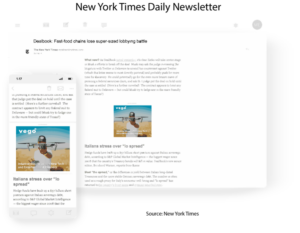
For local news sites, this gap creates an opportunity for one of the most underused assets in political media: editorial newsletters. From the NYT and WSJ local editions to city and regional outlets, newsletters deliver higher engagement than almost any other digital surface. They also put political ads in front of folks who are engaged with their communities and with the news about those communities.
This should be great news for publishers.
Why newsletters punch above their weight
A reader will choose to open an opt-in newsletter that lands in their inbox. That’s a fundamentally different relationship than a banner ad glimpsed on a scroll. Industry benchmarks put local newsletter open rates between 2.0% and 3.5% — compare that to programmatic display click-through rates that hover around 0.07%.
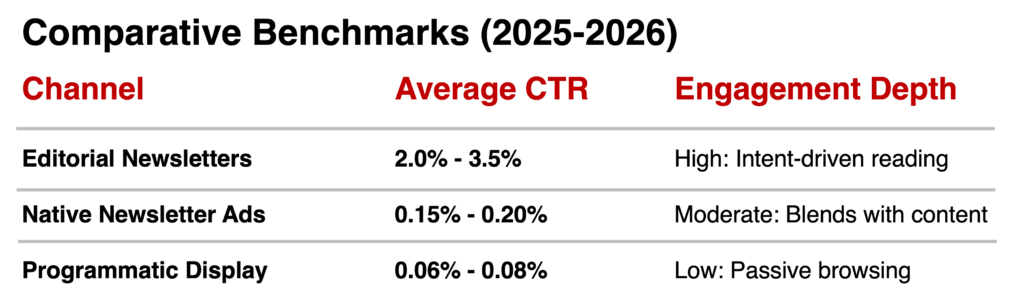
For a campaign trying to persuade a ticket-splitter or turn out a low-propensity voter, that level of attention is gold. These aren’t passive eyeballs; they’re readers who’ve opted into a daily or weekly habit with a trusted local brand.
And unlike a :30 CTV spot that interrupts, a newsletter placement sits next to the news that readers came for — school board coverage, city council votes, the zoning fight down the street. That’s the exact environment a political message wants to live in and why those nightly newscasts are popular political ad buys.
What’s really holding publishers back
The honest answer: many local publishers can describe their newsletter audience in broad strokes — “engaged local readers” — but can’t answer the questions a political buyer actually asks. How many subscribers sit inside the target congressional district? How many are voters? What’s the open rate in the last 30 days by zip code?
It’s more than you think.
Many sites with strong print affiliations simply haven’t had to quantify their digital readers before — geography has controlled the buyer-and-seller conversation for too long. But without those digital answers, the buyer moves on. In an election cycle projected to clear $10.8 billion in political ad spending, the publishers who can articulate their digital audience will capture budget the others leave on the table.
Publisher data doesn’t need to be perfect — but it needs to be legible. Subscriber counts, geographic distribution, open and click rates, a sense of reader demographics: that’s enough to put a newsletter on a media plan. The work for publishers is packaging what they already have in a form a political buyer can act on.
That’s the conversation Spot-On was built to have. Our Pinpoint Persuasion Platform was designed by political people for political buyers. We translate publisher data into the targeting and reach metrics campaigns need, we respect the political rate card, and we give creative review before ads run.
We’re adding publishers and newsletter inventory every week ahead of the 2026 primaries.
If your outlet isn’t on our list yet, drop a note to cnolan@spot-on.com. The buyers are looking.