


There is nothing us political ad folks love more than video — whether it’s streaming, linear television, or even hopping around on a TikTok screen. Nothing.
Video ads have endured for a simple reason: they work. For many voters, television ads are political advertising. Almost nothing communicates a political message more clearly than a well-produced :30 or :15 spot. In a crowded media environment, a strong piece of video can deliver a message quickly, emotionally, and memorably.
But despite its popularity, streaming video isn’t ubiquitous. In the fractured media environment we’re living in right now, video — like everything else — has its limits. Ironically, those limits are often a direct reflection of the same strengths that made video so powerful in the first place.
If you live in a city or suburb, you probably enjoy the benefits of modern broadband transmission. Home connections can approach or exceed 100 Mbps, while mobile networks deliver even faster speeds. In many places, it feels like high-speed connectivity is simply a given. Even the FCC’s long-standing minimum standard of 25 Mbps is commonly exceeded in urban and suburban areas.
Streaming platforms like Netflix, Apple TV, and Amazon Prime typically require at least 5 Mbps to deliver a stable high-definition picture without buffering lapses. That means streaming high-definition video, running multiple gaming sessions in the basement, or hosting a holiday weekend house full of screens and their human viewers is usually not a big deal — assuming you can afford the service.
The reality looks very different for voters in rural communities across the United States. Many residents simply don’t have reliable access to those speeds — and even when the infrastructure exists, the cost can put it out of reach.
High-speed internet access isn’t cheap. In 2024, the Federal Communications Commission estimated that more than 45 million Americans lack reliable high-speed broadband access. Independent researchers have suggested that the number may actually be higher, arguing that official counts often overstate real-world availability.
And it’s probably not getting any better soon. Getting high speed access to rural communities means someone has to drag the cables out to those homes and businesses— and this rollout is not happening very quickly.
For political ad buyers, this creates what we call a CTV drought — a meaningful gap between where streaming video can reach voters and where campaigns actually need to communicate.
Take Texas as an example. In major metropolitan areas like Dallas, Austin, Houston, and San Antonio, CTV coverage is strong and growing. But across large portions of West Texas, the Panhandle, and parts of southeastern Texas, broadband limitations can significantly reduce the reach and reliability of streaming platforms. 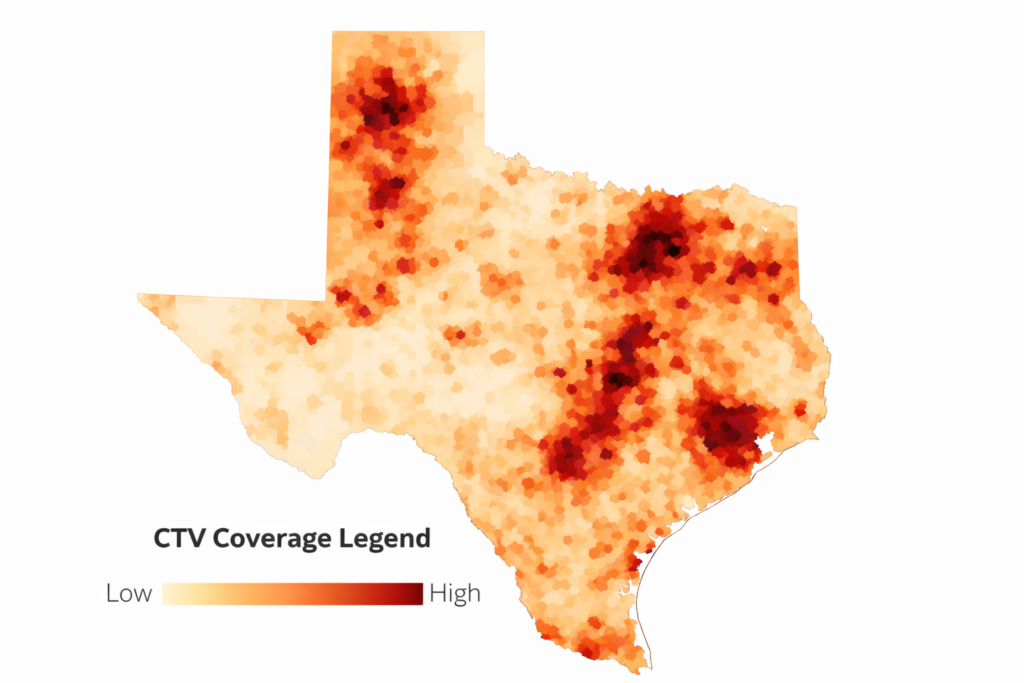 In these communities, campaigns that rely too heavily on CTV risk missing meaningful segments of the electorate.
There’s another fly in the ointment for political ad buyers. Many of the largest streaming services — including several of the platforms mentioned earlier — simply don’t accept political advertising at all. So even if you produce a compelling video spot, there’s no guarantee those viewers will ever see it on those platforms.
Fortunately, there is a way to close the CTV drought gap — but it requires looking beyond traditional digital advertising or streaming platforms.
Local news sites in these communities provide a direct connection to voters who are engaged with what’s happening around them. While much has been written about the supposed “death of local news,” far less attention has been paid to its quiet reinvention.
Several independent media companies — including Adams Publishing Group, CherryRoad Media, and Hoffman Media — are steadily rebuilding local journalism businesses across rural and small-town America. They are acquiring struggling newspapers and modernizing them with websites, newsletters, podcasts, and other digital offerings designed to reach audiences where they already spend their time.
Not surprisingly, many of these outlets don’t rely heavily on video. In fact, in communities where broadband bandwidth is limited, video-heavy strategies would likely be wasted anyway. Instead, these sites often maintain strong newsletter subscriber bases and loyal readership that returns daily for community coverage.
More importantly, these newsrooms are staffed by journalists and publishers who know — and are known to — their communities. That local credibility matters. When voters are trying to understand what’s happening in their town, their school district, or their county government, local news outlets remain one of the most trusted sources of information.
Which brings us to the part about knowing where to look.
Spot-On’s Pinpoint Persuasion Platform (P3) maps more than 3,000 local news outlets across the United States. The platform gives political media buyers on-the-ground intelligence about these outlets — including their audiences, geographic coverage areas, advertising formats, and available inventory. We even include details about newsletter audiences and other engagement channels where available.
And when video is an option, we’ll tell you that too. But just as importantly, we’ll tell you when video probably isn’t the right format for reaching voters in a particular community.
We’re happy to provide a free assessment of your current CTV and digital media coverage gaps through a P3 demo. If you’re planning media buys for the upcoming cycle, we’d be glad to walk you through how campaigns are using local news networks to reach voters who fall outside the traditional streaming ecosystem. Give us a shout and we’ll set one up.